
Sustainability is becoming a core principle for many new companies, built directly into their foundation. For organizations with decades of history, however, it often emerged more as a byproduct of resourcefulness than a deliberate strategy.
That was the case for Italian trims manufacturer Vivolo. Matteo Vivolo, chief sales officer at Vivolo and son of founder Luciano Vivolo, said the company was born from a personal and concrete need.
“In the late 1970s, my father began cutting pieces of discarded leather to repair my brother’s worn-out trousers. A simple, everyday gesture, driven by necessity rather than vision,” he told Sourcing Journal. “What might seem like a small and almost obvious idea today, reusing waste, was, at the time, a completely different way of looking at materials. It meant recognizing value where others saw none.”
That intuition became the foundation to the family-owned company. Over time, Vivolo said it has evolved into a broader philosophy: respecting materials, understanding their potential, and enhancing them through design, technique and craftsmanship. “Today, that same mindset still guides our approach to innovation. We explore new materials and processes, but the principle remains unchanged: innovation starts from respect for the material, and for the knowledge required to transform it,” he said.
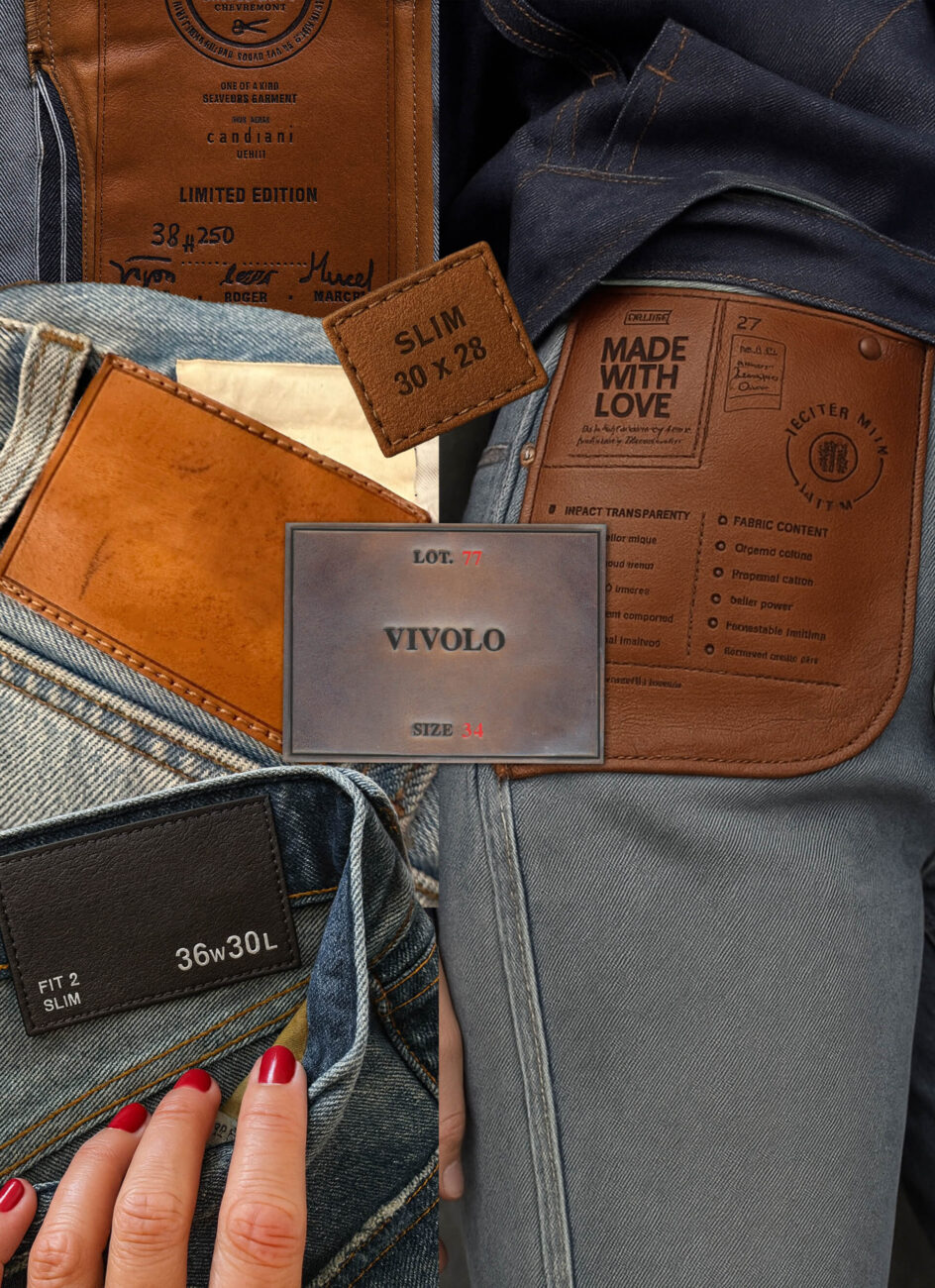
The company produces over 15 million products a year at its San Lazzaro di Savena headquarter. Vivolo’s specialty is in creating fabric labels, back patches, rivets, hangtags, patches and more with minimal environmental impact, utilizing materials that are organic, recycled, recyclable, compostable, vegan, animal free and solvent free.
“We started from reuse, but over time we understood that sustainability cannot be reduced to a single action, it has to be a system,” Vivolo said. Today, Vivolo’s sustainable mission begins at the design stage and continues throughout the entire process from energy, water, materials, certifications and supply chain structure.
“At the same time, we believe it’s important to bring clarity,” he said. “Leather, when managed responsibly, is a natural and durable material. The real challenge is not just choosing “different” materials, but using existing ones better, with more awareness and responsibility.”
While the company’s humble beginnings began as a simple mending solution, Vivolo believes the future of trims will be about integration between craftsmanship and technology.
“We will see new materials, including hybrids between leather and plant-based fibers, more sustainable processes, and even trims that can interact or communicate additional information. But one thing will remain essential: authenticity,” he said. “Even in a more technological future, people will continue to look for something real, something they can touch, feel and recognize as true.”
North American growth
That balance of forward-thinking materials and traditional techniques resonates with Vivolo’s clients in North America, where the company is currently observing significant growth.
Vivolo describes it as bringing “heritage into an industrial dimension.”
“The North American market has a very strong identity, especially in denim, it’s rooted in authenticity, heritage and consistency,” Vivolo said. “Our growth there comes from understanding that culture and translating it through our own approach. We bring Italian craftsmanship, material research and aesthetic sensitivity, but we combine it with the level of efficiency, speed and scalability required by large American brands.”
Whereas European brands are often experimental, Vivolo said American brands tend to favor a more iconic, clean and timeless aesthetic, closely linked to the roots of denim. A strong sense of continuity and recognizability guides brands’ creative directions.
“These two approaches require different solutions, but they are both extremely stimulating from a creative perspective,” he said.
The U.S. market is a reference point for the company. “Denim culture was born there, and many of the key decisions that shape the industry still originate there. Being present means being part of that ecosystem,” Vivolo said. “Our goal is to strengthen our presence not only commercially, but also logistically and creatively, to stay closer to our partners, respond faster to their needs and be able to anticipate their evolution.”
Storytelling elements
Trims cannot be ignored in denim’s evolution from reliable uniform cloth to being a uniquely personal foundational piece in consumers’ wardrobes.
“If you look at denim today, the fabric itself has reached very high and often comparable standards across brands. When that happens, differentiation naturally shifts to other elements, and trims have become central,” Vivolo said.
Denim brands would be remiss to underestimate the significance of a leather patch on their jeans. “It’s one of the few elements where a brand can truly express its identity,” Vivolo said. “In just a few square centimeters, it can communicate heritage, positioning and quality. In many ways, trims have become the most compact form of storytelling in a garment.”
Vivolo emphasizes details matter more than ever. In a crowded market, the challenge is to be immediately recognizable. Classic and chenille embroidery, leather braiding, needling, carpet stitch, patchwork, foil print and hand painting are just some of the techniques the firm uses to transform trims from functional elements to small yet impactful branding solutions.
“A leather patch is no longer just a logo—it’s a narrative tool,” he said. “Through materials, textures, embossing and finishes, brands communicate their values and their level of quality. It’s often the first element the consumer notices and touches. And that first impression is crucial. If the detail speaks the right language, the entire product gains credibility: it’s often the smallest element that carries the strongest message.”
With marketing messages like “buy less, buy better” gaining momentum, and denim brands elevating their collections through premium fibers such as Tencel, linen, silk, wool, and cashmere, trims must reflect the same commitment to quality and longevity.
“Perceived quality often starts with touch: in entry-level products, a well-made trim can immediately elevate the garment and make it feel more valuable. It creates a sense of care and intention. In luxury, the dynamic changes,” Vivolo said. “The trim becomes a confirmation; it reassures the customer that every detail has been considered. If the detail is perfect, the consumer assumes the entire garment is as well.”
Despite ongoing shifts in consumer behavior and how denim is made and sold, there are lessons from Vivolo’s earliest days that continue to ring true.
“In the early days, we didn’t have many resources, but we had to find solutions. That teaches you something very important: creativity is not about adding, it’s about solving,” Vivolo said.
Vivolo calls it creative resilience—the idea that excellence is not only in the raw material, but in the intelligence behind how you work it.
“Over time, that mindset became part of our identity,” he said. “It’s what allows us to stay flexible, to adapt quickly, and to build long-term relationships with brands that need both creativity and reliability. That balance between creativity and problem-solving is still what defines us today.”
Credits: WWD – SJ Denim